
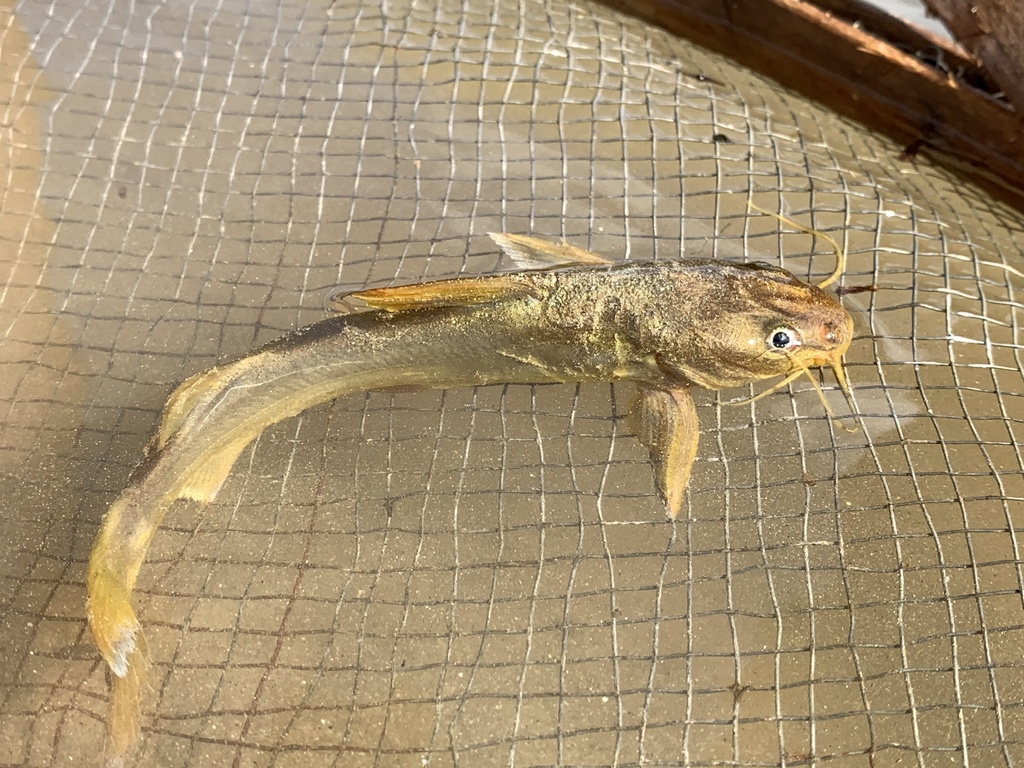
Cathorops steindachneri
- Usual depth8–153 m
- Water temperature27–29 °C
- Best monthsMarch and August
- How commonRare
About this species
Cathorops steindachneri, or Steindachner's sea catfish, is a species of catfish in the family Ariidae. It was described by Charles Henry Gilbert and Edwin Chapin Starks in 1904. It is a tropical, marine and freshwater-dwelling catfish which occurs between Costa Rica and Peru. It dwells at a maximum depth of 20 m (66 ft). It reaches a maximum total length of 36 cm (14 in), more commonly reaching a TL of 20 cm (7.9 in).
Text from the Wikipedia article “Cathorops steindachneri”, licensed CC BY-SA 4.0. Read the article
Where and when
Where it has been recorded
Worldwide
Best months
Worldwide (open data)
- January: 0 records
- February: 0 records
- March: 2 records
- April: 0 records
- May: 0 records
- June: 0 records
- July: 0 records
- August: 2 records
- September: 1 record
- October: 1 record
- November: 1 record
- December: 0 records
Depth and water temperature
Depth
Mostly recorded at 8–153 m · Deepest record: 153 m
Water temperature
Recorded in surface water of 27–29 °C
Names and classification
Other scientific names: Arius steindachneri, Cathorops steindechneri, Tachysurus steindachneri
Similar species
 Raspfin sea catfish
Cathorops spixii
- Big-bellied sea catfish
Cathorops dasycephalus
- Congo sea catfish
Cathorops fuerthii
- Gloomy sea catfish
Cathorops hypophthalmus
- Box sea catfish
Cathorops multiradiatus
- Besudo sea catfish
Cathorops tuyra
Sources and credits
Names and taxonomy: WoRMS (CC BY 4.0) and the GBIF Backbone (CC BY 4.0). Photos: iNaturalist observers, each under the licence shown (CC0, CC BY or CC BY-SA).
- Depth, temperature, months and maps: records from OBIS and GBIF under CC0 or CC BY.
- Descriptions: Wikipedia, licensed CC BY-SA, each linked to its article.
- Conservation status as published by GBIF (IUCN Red List).
- 73 open-data records from 1992 to 2021.
- Species data updated November 9, 2026.
Log what you see on your next dive
The free DiveHive diver app keeps your logbook with every sighting and shows what lives at the site you dive next.