
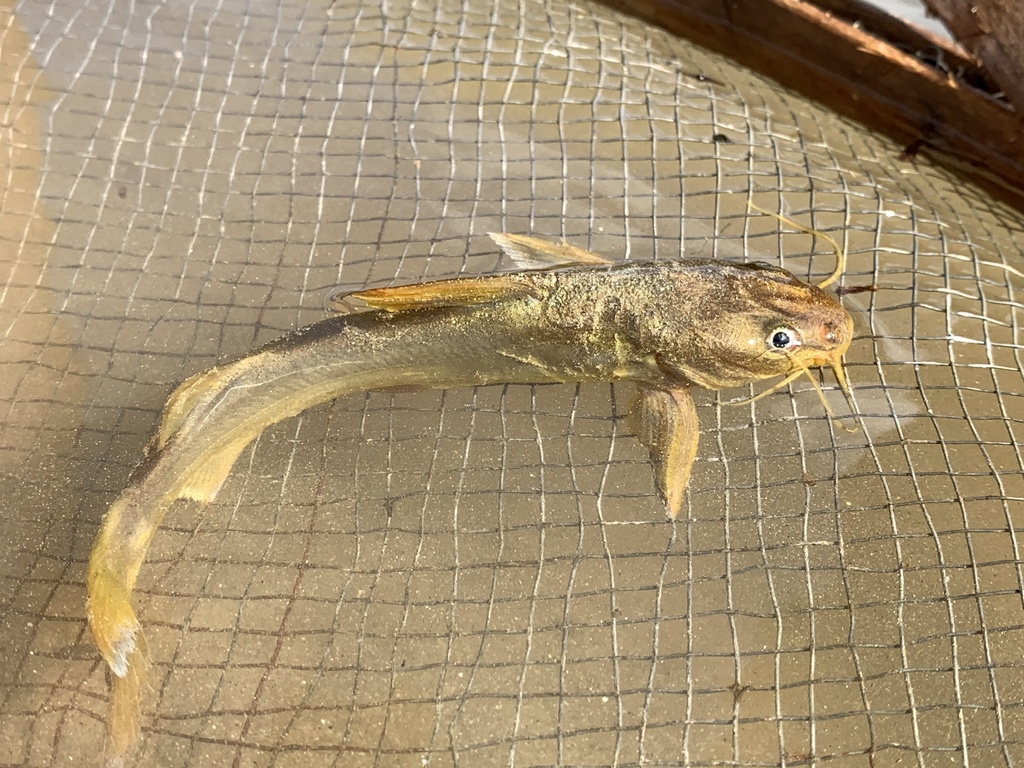
Box sea catfish
Cathorops multiradiatus
- Usual depth1–18 m
- Water temperature24–27 °C
- Best monthsMay and October
- How commonRare
About this species
Cathorops multiradiatus, the box sea catfish, is a species of catfish in the family Ariidae. It was described by Albert Günther in 1864. It is a tropical, marine catfish which occurs in Guatemala, Costa Rica, El Salvador, Colombia, Peru, Ecuador, Mexico, Nicaragua, Honduras, and Panama. It dwells at a maximum depth of 20 m (66 ft). It reaches a 30 cm (12 in).
Text from the Wikipedia article “Cathorops multiradiatus”, licensed CC BY-SA 4.0. Read the article
Where and when
Where it has been recorded
Worldwide
Best months
Worldwide (open data)
- January: 0 records
- February: 0 records
- March: 1 record
- April: 0 records
- May: 2 records
- June: 0 records
- July: 0 records
- August: 1 record
- September: 1 record
- October: 2 records
- November: 0 records
- December: 0 records
Depth and water temperature
Depth
Mostly recorded at 1–18 m · Deepest record: 18.3 m
Water temperature
Recorded in surface water of 24–27 °C
Names and classification
- English
- Box sea catfish
Names in 2 more languages
- Spanish
- Bagre cajeta, Cajeta
- French
- Mâchoiron coffre
Other scientific names: Arius multiradiatus, Bagrus arioides, Tachysurus emmelane, Tachysurus equatorialis
Similar species
 Raspfin sea catfish
Cathorops spixii
- Big-bellied sea catfish
Cathorops dasycephalus
- Congo sea catfish
Cathorops fuerthii
- Gloomy sea catfish
Cathorops hypophthalmus
- Besudo sea catfish
Cathorops tuyra
Sources and credits
Names and taxonomy: WoRMS (CC BY 4.0) and the GBIF Backbone (CC BY 4.0). Photos: iNaturalist observers, each under the licence shown (CC0, CC BY or CC BY-SA).
- Depth, temperature, months and maps: records from OBIS and GBIF under CC0 or CC BY.
- Descriptions: Wikipedia, licensed CC BY-SA, each linked to its article.
- Conservation status as published by GBIF (IUCN Red List).
- 23 open-data records from 1941 to 1970.
- Species data updated November 9, 2026.
Log what you see on your next dive
The free DiveHive diver app keeps your logbook with every sighting and shows what lives at the site you dive next.